↧
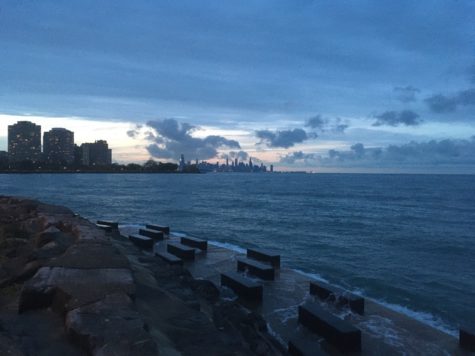
Chicago skyline from the point
↧
Dispatches From a Fishless Lake
If you, like me, have an itch to uncover our city’s piscine history, go to the Chicago History Museum’s online photo archive and type “smelt fishing” into the search bar. About 40 images will appear, black and white photos from the ’60s and ’70s. All are taken at night, when artificial light sources can be used to lure smelt, a small migratory fish, towards the surface. There, they are easily netted, or “dipped.” The dippers’ windbreakers and wool hats attest to the month, April—its chilly but increasingly warming nights cuing the smelt into their yearly migration up to the Great Lakes tributary rivers they spawn in.
On that April 22nd, 1976—the day most of the photos were taken—fishing groups stretched all the way down the North Avenue Pier in Lincoln Park. A broad slice of humanity is on display. One group has built a bonfire out of those flimsy wooden fences you can still find on all the Chicago beaches. Four young children sit beside it on a wall, framed by the skyline, paying rapt attention to a story being told by a standing man. Another group divides their labor between netting the smelt and immediately charcoal-grilling them, the latter job belonging to a modest-looking pair while their grinning friend, dapper in his white-trimmed leather jacket and sea captain’s hat, commands the former.
In another image, a father and his sons run down the pier with buckets in their hands, faces giddy. Apart from the rest, a small group of three sit by the light of only one lantern, casting long shadows over the pier. Two of them, one silhouetted and one drenched in the lantern’s white light, sit and face the third, who is the picture of concentration as he crouches over some small tool or implement. Two lines extend off the pier and into the water that blends into blackness with the sky. The thawing waves lap, and the smelt flit and turn below, while the lights on the edge of the city twinkle coldly and far away.
As it did on this night, fishing has signified community, sustenance, and ritual to generations of Chicagoans. A lived connection to the lake endured even as skyscrapers surged into the sky and concrete choked the marshy shore. But beneath the waves, an ecocidal drama played itself out. Its initiator was commerce and progress, its characters are obscure aquatic species, and its conclusion is a lake left barren. That’s what we have left today.
***
Lake Michigan, before settling into its current basin, was cyclically pushed southward and pulled northward by the oscillating continental glaciers of successive Ice Ages. Over thousands of years, the lake became populated by the “hardy fish and other aquatic species that had been dwelling in the melted waters just beyond the glacier’s reach,” journalist Dan Egan writes in his 2017 book The Death and Life of the Great Lakes. And when the most recent of the glaciers receded about 4,000 years ago, these species came to constitute the ecosystem of Lake Michigan as well as the Great Lakes at large. Cut off from the Atlantic Ocean by the rapid currents and steep ledges of Niagara Falls, the lakes’ ecosystem was protected from any incursions by oceanic species.
Like any healthy ecosystem, the food web of the lake was complex. Everything depended on algae-like phytoplankton, and the tiny zooplankton that ate them. Small fish ate this plankton, and bigger fish ate the smaller fish, but some larger fish also ate plankton. Some smaller fish preyed on the eggs and young of bigger fish, while a few focused on insects. Add mollusks and crustaceans to the mix, and you’ve got a tangled web of cohabitation, predation, and codependence featuring some commonly known species—perch, bass, and muskies—some that have since been decimated by the ecological changes that humans have wrought—fatmucket clam, lake trout—and some that live on, hiding in the deep water’s obscurity—burbots, sculpins.
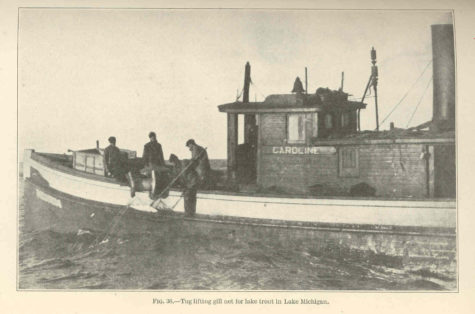
But of all the lake’s species, lake trout was king. Trout, which still live in the lake, can grow up to and live for decades. In years when food is scarce, they stop growing to save energy. In years of plenty, they resume devouring everything in their path, from plankton and insects to other fish. This incredible flexibility and longevity allowed the lake trout to form specialized colonies “uniquely adapted to thrive in the areas it colonized,” Egan writes. Bottom-dwelling trout developed eyes closer to the tops of their heads; those near streams adapted to migrate upstream to spawn like salmon, while those in deep water grew more body fat to remain buoyant near the lake’s floor. The region’s early European settlers gave these separate colonies names like yellow fins, buckskins, grease balls, and moss trout. Initially, the most effective method these men had for catching the trout was to let an angry hooked trout drag the boat around until it grew tired enough for the men to pull it out of the water. Native American tribes would net and spear the trout when they migrated to shallow water to spawn every fall, using the upcoming winter weather as a natural storage mechanism. Even as commercial fishing took off and led to concerns about overharvesting, yields remained remarkably high—by Egan’s account, 8 million pounds of lake trout were being pulled out of Lake Michigan every year at the turn of the 20th century. But the lake’s diversity and bounty were tenuously protected by just one single geologic formation—Niagara Falls. Under the banner of progress, humans soon overcame this barrier, changing the lakes for good.
***
The first character in the ecocidal drama is not a fish, but Canada’s Welland Canal. Built between St. Catherine’s and Port Colborne in the province of Ontario, it finally gave Lake Ontario and Lake Erie a connection by water other than the Niagara River and its famous falls, impassable to ships. Since the canal opened in 1829, it was enlarged and deepened throughout the following decades, allowing organisms native to the Atlantic Ocean, St. Lawrence River, and downstream Lake Ontario to use the artificial navigation channel to enter the remaining four Great Lakes’ isolated ecosystem.
The sea lamprey was the first truly destructive example of these Welland Canal invaders. With its eel-like body and perfectly round, perpetually open mouth that’s lined with dozens of tiny teeth, it’s a scary fish. And it’s a real threat, too: It uses this mouth to latch on to other fish and bleed them out until they die. In the Atlantic Ocean, it’s kept in check by larger predators like cod. But as soon as it got into Lake Erie, then Huron and Michigan, it was open season. What became of the resplendent, kingly lake trout? Lake Michigan’s catch decreased from 6.5 million pounds in 1944 to a mere 342,000 pounds in 1949, and none at all five years later, with the lamprey to blame.
The next character in the drama is a person: Vernon Applegate, a University of Michigan doctoral student. Applegate knew that most of a sea lamprey’s life is spent burrowed into the bank of a stream, sucking tiny bits of food out of the water until it grows large enough to go out into the open water and feast on larger fish’s blood. So he camped out at one of these streams in northern Michigan, intent on finding a weakness in the invader’s life cycle that could be targeted, controlling the lamprey infestation. Egan writes that the scientist would chase the parasites “up rivers through the night and into dawn with flashlights and a notebook,” and that Applegate “built outdoor pens to watch them breed.”
Applegate was obsessive, “living on cigarettes and aspirin.” He tracked their migration schedule to the week, and realized that the most effective control would be a poison, a “lampricide” that would kill off the invaders in their streams before they ever got to the lake, leaving other fish unharmed. So the mad scientist started another multi-year project, this time at a remote research station on Michigan’s Lake Huron shoreline: testing thousands of chemicals, sent by chemical corporations all over the country, by mixing them into a fish tank containing two juvenile lampreys and two native fish. The 5,209th chemical was the one that finally killed the lampreys and spared the others. By 1967, the poison had driven the lamprey population to a 10th of what it had been, and it remains at that level today thanks to a long-running lampricide program administered by the United States and Canada.
Enter the alewife. This fish had snuck in through the Welland Canal with the lamprey. Too small for the bloodsucker, and completely unchecked by the decimated lake trout and whitefish, alewife populations exploded: Scientists estimated that they accounted for 90% of Lake Michigan’s fish mass in 1965. Great Lakes fishermen attempted to make an industry out of this new invader as East Coast fishermen had done for centuries, but the lake proved not to be salty enough to sustain the alewife long-term. They came to shore another way: foot-deep mats of decaying sludge washed up on the beaches of Lake Michigan, including Chicago’s entire urban lakeshore. The city had to use bulldozers to dispose of them. Morale was low, and some park workers even quit in disgust.
Then came the salmon. Ignoring a federal project reintroducing lake trout to the now-cleansed Lake Michigan, the State of Michigan’s Head of Fisheries Howard Tanner brought salmon eggs from the Pacific Northwest and started stocking the lakes with these instead. He was focused on boosting recreational fishing and believed the non-native salmon provided a more interesting fight when hooked than the trout did. The salmon would also gobble up what was left of the alewife, preventing another beaching event. The stocking program proved highly successful, with the Pacific newcomers establishing their own runs up local rivers and filling up the empty lakes, overrunning the native holdouts that might have finally had a chance at post-lamprey resurgence. Tanner didn’t particularly care: By the 1970s, recreational fishing in Michigan had skyrocketed. Piers all along the state’s enormous coastline became, essentially, constant tailgates while lakeside communities raked in the profits of tourism.
The act of environmental engineering didn’t stick. In the late ’80s, the salmon started declining. So did the alewife, though there were fewer salmon to eat them. So did all the native holdouts, though there were fewer alewives to prey on their eggs. The culprit was an invader that put the nail in the ecological coffin: zebra mussels.
This mussel is native to Ukraine’s Dnieper River estuary, a region known for its oscillations in salinity. This made them well-equipped to travel in the ballast tanks of ships, floating in the water that ships take in for balance. Oceangoing vessels did this in ports all over the world, and then flushing and replacing the water at port in the Great Lakes. Once they made it over, zebra mussels spread across Lake Michigan’s bottom like spilt water on a tabletop, eating up all the plankton and starving the fish further up the food web. The related quagga mussel did the same thing 10 years later, even spreading to deeper areas that had been inaccessible to the zebra mussel. “Lake Michigan,” University of Wisconsin-Milwaukee School of Freshwater Sciences ecologist John Janssen tells me, “is basically just a giant mussel bed now.”
***
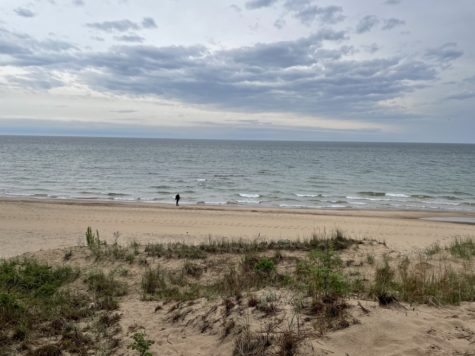
Go to the lakeshore, and you will see the traces. Washed up on the beaches, along with the driftwood, bottle caps, and plastic straws, are snaking lines of the mussels’ tiny shells. Step in the water and you’ll remark how clear it is. That’s on account of the mussels filtering out all the microorganisms that typically cloud fresh water. If you swim out to a buoy, a water intake station, or a pier, you’ll find them bristling across the surface, too small to harvest and eat but large enough to cut and pierce your skin. And if you notice any dead shorebirds, know that the new water clarity helps the growth of algae that deoxygenate Lake Michigan, creating ideal conditions for the proliferation of the avian botulism bacteria.
Various fishing traditions have suffered as the lake has become barren. Ojibwe and Winnebago fishermen sitting in birch-bark canoes once speared fish by torchlight and wove nets out of nettle plants to catch a large part of their yearly sustenance. Even as settlers encroached and environmental problems mounted, tribes forcefully defended their treaty-stipulated fishing rights. Gone are the days when South Side steelworkers would take their skiffs out on weekends and fish to supplement their wages. Before World War II, most Chicago fishing outfits belonged to this category. And if you go to Diversey Parkway bridge across the Chicago River, you won’t find fishing trawlers unloading their smelt bycatch and frying it for passers-by in what one Chicagoan recalls as a stream of “gruff talk and jabs and winks.” Under combined pressure from environmental degradation and the recreational fishing lobby, the Illinois Department of Conservation limited lake fishing licenses from 45 to just three, instituting a lottery for the coveted spots and driving many family operations out of business. Now, to the average University of Chicago student and most Chicagoans, Lake Michigan exists for recreational purposes only, severed from our food system and economy by the waves of invasive species that have left it empty.
There are always those who try to gather something from the wreckage. Through all the ecological turbulence, a federal lake trout reintroduction program has been stubbornly running on Lake Michigan for decades. The fish is a draw for Chicago anglers, as any cursory glance at the bullishly alive Chicago fishing community on Reddit will reveal. Raising fish in hatcheries and releasing them for recreational anglers to catch is no replacement for a functioning ecosystem. But in 2001, Janssen was finally able to record the first evidence of natural lake trout reproduction in the lake, zebra mussels notwithstanding. He continues his lake trout monitoring to this day, and was preparing to go on a multi-day boating trip to investigate potential trout spawning areas in Lake Superior when I spoke to him.
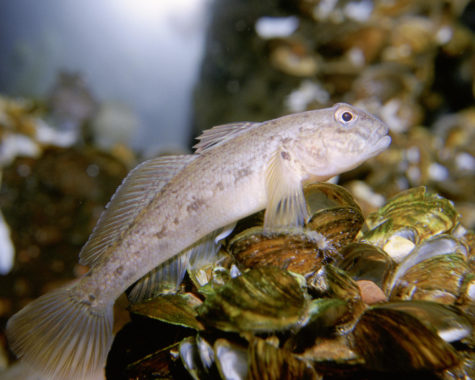
He explains that in a lake, this warped invasive species can have good consequences, too. One of the Great Lakes’ new arrivals is the round goby, native to the same European waters as zebra mussels, and a prodigious eater of the mollusks: It’s already succeeded in driving the scourge out of Wisconsin’s Green Bay. Unexpectedly, native bass really took to the gobies, so much so that bass fishing in Lake Michigan is on the up. Howard Tanner’s salmon still have their runs, too, and the Chicago Sun-Times’ outdoors column reports on prize catches made by urban anglers throughout the summer.
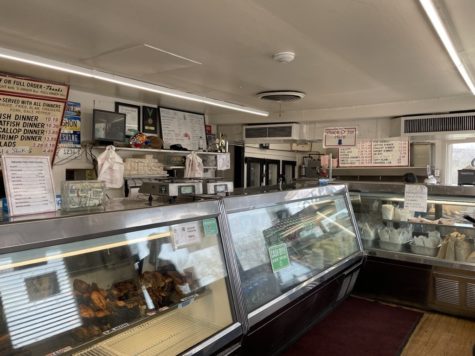
Some commercial fishing operations have held on. Most are in Lake Superior, though one in Lake Michigan still fishes for the elusive burbot, a bottom-dwelling relative of cod that is barely researched due to its inaccessible habitat. The more common catches are familiar lake trout and whitefish, battered but not beaten in northerly Lake Superior, where low calcium levels make zebra mussel growth difficult. A taste of these resilient fish—and a connection to the lake that goes beyond wading in, deciding it’s too cold, and wading back out—can be found just a few Metra stops south of campus at Calumet Fisheries, an old-fashioned smokehouse perched on the side of Calumet River.
The place is surrounded by creaking old bridges, highway overpasses, and post-industrial junkyards, surviving with the same kind of tenacity that drives scientists like Janssen back to the lakes they’ve lived their lives by. Founded in the 1920s under a different name, Calumet Fisheries survived the deindustrialization in South Chicago that deprived it of steelworkers stopping for a bite after their shift; it has flourished in the 21st century despite the bleak, disused landscape that has set in around it. Part of that is thanks to a feature on Anthony Bourdain’s No Reservations, but most of it has been on account of the place itself. The customers are loyal and have been coming for decades. It has deep local roots, embodied by store manager Javier Magellanes, a young man only a couple years older than some of the students reading this newspaper. He started working at the smokehouse as an after-school job while growing up in the neighboring East Side neighborhood and rose through the ranks until the store was entrusted to him. He takes me to see the main component of the store’s stubborn excellence: the smoking itself.
Great Lakes trout, whitefish, and smelt, along with imported shrimp and salmon, are brought on the previous afternoon in a small truck. It sits in a secret brine overnight until the worker with the morning shift comes in at 5 a.m. to start the smoking process. The fish is sliced into what’s known as a “darne” shape at this point: the bones and organs taken out so that the cross-section of the fish resembles a tooth or a horseshoe. It’s hung from strings on metal rods near the top of the little brick smoking shack next to the shop (made from the “good” Chicago bricks of the early 20th century, Javier says). Oak logs are put on a movable grate sitting on the ground and pushed inside with the flame burning. The door is closed: This part is for heating up the inside of the smokehouse enough to cook the fish. Once it’s cooked, the worker dons heavy-duty work gloves and protective glasses to replace oak with the smokier cherry. It’s periodically pushed in and out of the smokehouse while the door is kept open, giving the fish its smoky taste after it’s been cooked through. I ask Javier if he can stand to eat fish in his free time anymore.
“Yes, I never get tired of our fish,” he says. “But bonfires are the real problem. I smell like smoke every single day. I do laundry all the time. When a buddy invites me to a bonfire in his yard on the weekend, I just can’t bring myself to go. I can’t be smelling like smoke on the weekends too.”
***
Calumet Fisheries smokes up some delicious fish, but it’s paltry consolation for the cold, hard fact: The piscine history of Chicago is an ecological catastrophe. Think about it too much, and the waves start to lap with the silence of annihilation. The fishermen on the piers lose their idyllic sheen and seem more like Sisyphus than like Hemingway’s Old Man. The stray birds probably eat more pizza crusts than they do fish. And the supermarket fish we eat for dinner—Alaskan salmon, Icelandic cod, Mississippi catfish—is just faceless fillet, pastiche product.
The joy that Calumet Fisheries or a big salmon catch may bring is put in perspective by something called ecological baseline shift: What seems natural, healthy, and good to us is just a shadow of what there was as little as one lifetime ago. Compared to the days when European explorers wrote of catching 50 trout in a day, some “weighing half as much as man,” perhaps we’ll never be able to speak of a true ecosystem in Lake Michigan again.
Is this a surprise? An ecosystem with humans in it reflects the needs of those humans. Native peoples and early settlers depended on the lake for survival, so they kept it resilient and plentiful. Later commercial fishermen were feeding a booming nation; they pulled as many fish out as they could while the lake seemed to just keep on giving. We don’t need the lake’s ecosystem at all, with our transnational trade networks and supermarket habits. So most people didn’t blink an eye when it went barren. The ones that were affected almost seem like relics, weird holdouts.
In the struggle between nihilism and hope about the fish of Lake Michigan, perhaps it is fitting to end on these holdouts. One of them is an unidentified person in a red jacket, captured in a photo for the Chicago Sun-Times outdoors column, walking along the grand embankment between Shedd Aquarium and Adler Planetarium. It’s nighttime, and the city skyline glimmers in the background. They’ve got quite a setup: a picnic table, bags of food, fishing poles, buckets, a generator, and a grill. The photo was taken in April 2019. Is the water below empty? Maybe. Does it support a healthy ecosystem, streams of springtime smelt? Unlikely, but year to year, who’s to say? It seems that the lake behaves in the same ways this city does—always changing, always getting wiped clean just to be repopulated again. We have our fires and floods, the lake has its mussels and lampreys. Our riots and displacements are the lake’s disasters and die-offs. The smelt itself is an invasive species, one of the first, breaching the Welland Canal as early as the 1910s. That unsettling fact doesn’t bother the dippers; should it bother us? We mourn ecocide, but most of us are an invasive species too, raising a palatial boomtown on top some of marginal Potawatomi hunting land, erasing the prairie under a metastasizing array of smokestacks and roads, a needlework of billboards and apartment buildings. In their shadow, the artificial is disguised, the natural is muddled, and the smelt dippers will surely keep on dipping: two invasive species united in a primeval ritual. It’s absurd, tragic, and beautiful, and in Chicago, it might be the best that we can get.
↧
↧
Folk_Festival

↧
UChicago Medicine Abolishes $173.7 Million in Unpaid Medical Debt for 85,060 Patients
On October 25, UChicago Medicine announced their participation in Cook County’s Medical Debt Relief Initiative (MDRI), abolishing $173.7 million in unpaid medical debt for 85,060 Cook County residents who received care across the UChicago Medicine network. It is the largest bundle of medical debt forgiven since the MDRI was established in 2022 and brings the program’s total forgiven debt up to $281.3 million, impacting 158,541 county residents concentrated in the South Side and in the south suburbs.
The MDRI was launched using $12 million of funds allocated by the American Rescue Plan Act, the economic stimulus package signed into law by President Biden in 2021. MDRI partners with RIP Medical Debt, a charity that uses donations to purchase large amounts of old, uncollected debt from hospitals at a discount. Whereas collection companies would purchase this same debt and use aggressive methods like lawsuits to collect it, the charity forgives the debt.
Through RIP Medical Debt, small donations can be leveraged to forgive large debts. After the MDRI donates to RIP Medical Debt, the charity looks through indebted patient lists of Chicago-area healthcare providers and forgives those who either owe debts of more than 5 percent of their annual income or are earning under four times the federal poverty rate.
Unpaid medical debt is a growing issue nationally. Though hard to measure, a 2022 investigative project by National Public Radio and KFF Health News found it to affect more than 40 percent of American adults. A quarter of adults with medical debt owe over $5,000, and one in five say they do not expect to ever pay it off. Besides squeezing households to cut spending on food and other essentials, in around 17 percent of cases, medical debt forces people to declare bankruptcy or to lose their house.
Debt can vary greatly in size, meaning that high-income, insured adults are often affected too. But it is about 50 percent more likely to impact households earning under $40,000 a year than those earning over $90,000, and Black and Hispanic adults are 50 percent and 35 percent more likely, respectively, than white adults to owe money for health care.
UChicago Medicine’s primary service area includes many of Chicagoland’s lowest-income ZIP codes. These households are more likely to fall into medical debt, making the recent $173.7 million debt relief package a significant milestone for Cook County’s MDRI program.
Typically, UChicago Medicine includes debt it deems “unrecoverable” in its annual Community Benefit Report. In 2022, this amounted to $200 million out of a total “community benefit” of $686 million, with most of the remaining $486 million composed of financial losses from treating Medicare and Medicaid patients.
↧
Nurses’ Union Rally on MLK Day Draws Hundreds As Contract Negotiations With UCMed Continue
More than 200 UChicago Medicine (UCM) nurses and their allies took part in a rally organized by National Nurses United (NNU) Monday morning amid a months-long contract negotiation between the labor union and UCM.
Despite 15 meetings and 15 tentative agreements across nearly four months of negotiations, NNU says that UCM “refuses to take our patient concerns seriously.” These concerns include staffing issues like high patient-to-nurse ratios and low retention of recent hires, as well as the proposed inclusion of a trigger clause that would allow the union to bargain for certain guarantees in case of events such as a pandemic.
Braving subzero temperatures, nurses held picket signs and chanted at the intersection of East 58th Street and South Maryland Avenue in sight of all major UCM facilities in Hyde Park. They came bundled in puffer coats, huge blankets, and hunting jackets, and they cited a variety of reasons for attending.
One recently hired surgical nurse took issue with regularly being switched from one unit to another mid-shift, requiring difficult adjustments. An ICU nurse explained that she often handled up to three patients in life-threatening conditions at once and that UCM denied nurses the opportunity to take overtime shifts as a cost-cutting measure. A cardiac arrest nurse who began in March 2020 said that staffing issues had only worsened since the end of the COVID-19 pandemic.
Julie Kostynick, a Mitchell Hospital nurse who spoke at the rally, connected staffing issues to patient care. Mitchell is one of two main UChicago hospitals in Hyde Park along with the Center for Care and Discovery (CCD). According to Kostynick, Medicare and Medicaid patients, whose government insurance pays hospitals less per treatment than private insurers do, are disproportionately sent to Mitchell.
“Management would rather pull nurses to staff the hospital with fewer Medicare and Medicaid patients,” Kostynick said, adding that Mitchell patients regularly complain about cleanliness even as UCM management denies any disparities between the two hospitals.
“Patients over profits,” Kostynick said to cheers as she ended her speech.
Scott Mechanic, a CCD and Comer Children’s Hospital emergency room nurse participating in contract negotiations on behalf of NNU, explained that the rally was meant to pressure UCM during negotiations, particularly around insufficient staffing. Improving staff retention is a key aspect of nurses’ demands.
“Half of our nurses are new since the last contract was signed four years ago. Turnover’s been extreme,” Mechanic said. He cited burnout as a factor preventing nurses from remaining in their jobs for more than a few years and pointed to lower patient-to-staff ratios as a potential remedy. It’s a larger issue: according to the American Association of Colleges of Nursing, “insufficient staffing is raising the stress level of nurses, impacting job satisfaction, and driving many nurses to leave the profession.” This national shortage is set to intensify as the U.S. population ages.
Despite hardships on the job, nurses at the rally expressed pride in their work. One Mitchell nurse said that her unit was on the “front line” of mental health and violence issues on the South Side—identified as important concerns in UCM’s most recent Community Health Needs Assessment—and that she regularly deals with threats and verbal abuse, often from psychiatric patients. Though the nurse said these situations can be “frightening,” she added that “nurses put themselves last and patients first.” Many nurses wore their badges to the rally, either because they had just finished work or because they were simply “proud,” as one nurse said.
NNU’s choice of Martin Luther King Jr. Day for the rally reflected nurses’ pride and desire for fairness. U.S. Representative and 2023 Chicago mayoral candidate Jesús “Chuy” Garcia (D–Ill.), barely visible in a gray hoodie through the sidewalk crowd, said he was “proud to stand with those who have chosen to care and improve the lives of other people.” He praised their “selflessness” in working through the pandemic and for “keeping the legacy of Dr. King alive by standing up for justice.”
To these nurses, justice may require a strike. “We really hope we can avoid a strike. We’re going to need to see a lot of movement from the hospital, from where they’re at right now,” said Mechanic.
“It’s been a really hard four years for them,” Mechanic said of NNU’s nurses. “They are willing to strike for a better contract.”
In a statement to The Maroon, UCM said it was “continuing to work collaboratively with National Nurses United to reach a comprehensive contract agreement that meets the needs of our nurses, our growing healthcare organization and the community of patients who rely on us for care.”
According to UCM’s statement, NNU and UCM are meeting five times this month, including two sessions scheduled for later this week.
“We remain committed to working collaboratively and respectfully for a fair and equitable contract that allows us to continue to attract exceptional nurses who meaningfully contribute to our institution and its reputation for excellence,” the statement concluded.
↧
↧
UChicago Nurses Approve Strike Authorization
UChicago nurses voted Tuesday to authorize a strike as months-long contract negotiations between National Nurses United (NNU) and UChicago Medicine (UCM) have stalled. The vote does not mean a strike is certain but allows the labor union’s bargaining team to call a one-day strike at their discretion.
On its website, NNU said the bargaining team would call a strike if UCM management did not “address staffing concerns which lead to patient safety issues.”
At a rally held on Tuesday at the corner of 58th Street and Cottage Grove Avenue, ICU nurse and NNU bargaining team member Amber Turi said that “management has not moved at all on these core staffing issues,” despite 17 meetings and 24 tentative agreements with UCM.
Unresolved issues include low staffing levels at Mitchell Hospital, one of UCM’s two major hospitals in Hyde Park. According to Turi, Medicare and Medicaid patients, whose government insurance pays hospitals less per treatment than private insurers do, are disproportionately sent to Mitchell over UCM’s other major Hyde Park hospital, the Center for Care and Discovery. Over 70 percent of UCM’s self-defined “Primary Service Area” is Black and almost 40 percent is insured by Medicaid; Turi sees Mitchell’s “deliberate understaffing as a form of systemic racism.”
NNU claims many staffing issues date back to difficult working conditions during the COVID-19 pandemic. In NNU’s statement, Turi recounts having “no environmental services, no food service, no EKG techs, no supplies” at Mitchell Hospital during the COVID-19 pandemic. “UChicago refused to consider retention compensation during this difficult time, even though it was being offered at other hospitals,” Turi said.
Turi added that 60 percent of her nursing unit left their jobs during this time, and that the severe staffing issues have resulted in NNU nurses missing 244,946 lunches combined in fiscal year 2022. This means that the average NNU nurse at UChicago, often working a 12-hour shift, missed roughly 86 lunches in 2022.
While Turi delivered her remarks, nurses walked out of nearby hospital buildings in their scrubs to cast their ballots at NNU’s polling station, set up on the sidewalk as cars streamed by on Cottage Grove Avenue.
“Turnout’s been excellent,” Drew Castenson, a Mitchell nurse supervising the voting, said. Voting took place from 6 a.m. to 9 p.m. at UCM’s Hyde Park location and in shorter windows at UCM locations in South Shore, South Loop, and Orland Park, said Stephanie Gamboa, an outpatient clinic nurse on NNU’s bargaining team. Gamboa said that UCM has only moved on “small” points since a large NNU rally on January 15, and that the labor union is still looking for concessions on workplace safety and retirement in addition to staffing concerns.
Before the vote, Turi said that while they “do not want to strike,” calling one is “not off the table” for negotiators if the union’s rank and file authorized one.
“We cannot provide the highest quality of care when we are running on fumes,” emergency room nurse Scott Mechanic said. “We deserve better and our patients deserve better.”
While earlier this month, UCM laid off 180 administrative employees, citing difficult financial circumstances facing hospitals nationwide, the system has undertaken a number of capital projects. The medical system broke ground on an $815 million cancer care and research pavilion late last year and announced the launch of the Center to Eliminate Cancer Inequity (CinEQUITY) last week. UCM also acquired a controlling stake in four suburban hospitals in early 2023.
In a statement to The Maroon, UCM emphasized that a strike has only been authorized, not called, and wrote that “both sides have exchanged dozens of proposals, reaching roughly two dozen tentative agreements on a number of topics—seven during the last bargaining session alone. There also have been important conversations on key topics such as nurse education, staffing and compensation.”
Characterizing the negotiations so far as “steady progress,” UCM wrote that “the real work of reaching a contract can only be accomplished at the bargaining table, and UCMC [UChicago Medical Center] is committed to continuing good-faith negotiations.”
At least three more bargaining sessions are scheduled for February and March. UCM concluded that they “remain optimistic that both sides will reach an agreement that allows us to continue to retain and attract the high caliber of nurses who so meaningfully contribute to our reputation for providing excellent care.”
↧
A Timeline of Migrants in Hyde Park
April 13, 2022
Governor Greg Abbott (R-Texas) orders a bus of recently arrived migrants to Washington, D.C. This “busing strategy” is meant to undercut President Joe Biden’s upcoming cancellation of the public health regulations allowing for rapid expulsion of migrants crossing the border. It is the first moment in what will become a dependable strategy for Abbott and Florida Governor Ron DeSantis (R) and a national political flashpoint.
August 31, 2022
After sending over 7,000 migrants to New York City and Waxshington, D.C., since April, Abbott announces the first bus heading for Chicago, with 60 migrants on board. Abbott says that his state bears the brunt of Democratic lawmakers’ immigration policies. “[Former Chicago] Mayor Lightfoot loves to tout the responsibility of her city to welcome all regardless of legal status,” Abbott explains. “I look forward to seeing this responsibility in action.”
Mid-October, 2022
Over 3,000 migrants—mainly from Venezuela—have arrived in Chicago on buses chartered by Southern Republican governors. President of the Cook County Board of Commissioners Toni Preckwinkle calls the strategy “cynical” and “disgraceful.” Most migrants live in and around Chicago Police Department (CPD) police stations.
December 29, 2022
The city announces the conversion of Wadsworth Elementary, a shuttered school in majority-Black Woodlawn, into a migrant shelter. The announcement draws immediate criticism from the area’s alderwoman, Jeannette Taylor, as well as local residents, who claim the city was not transparent about its selection process for Wadsworth.
February 2, 2023
The city begins moving migrants into the Wadsworth Elementary School shelter despite protests of local residents, including two local residents attempting to physically block a bus carrying migrants. Wadsworth is one of many shelters on the South Side that spark criticism of the city’s prioritizing of migrants’ needs over those of underinvested neighborhoods and for sending migrants to these neighborhoods over wealthier ones.
February 13, 2023
Mayoral candidate Brandon Johnson unveils a migrant plan on the campaign trail, aiming to counter “forces seeking to divide” Black and Hispanic Chicagoans. His plan includes using a tax on high-end home sales to fund city shelters for asylum seekers and allowing residents to vote in Board of Education elections regardless of citizenship status.
May 31, 2023
A highly contentious City Council session ends with $51 million being allocated from the city budget towards the migrant crisis, with a vote of 34–13. Racial justice is a flashpoint as alderpersons and members of the public accuse the city of double standards, having failed to provide similar funding in underinvested, majority-Black neighborhoods.
June 2023
A team of primarily Venezuelan migrants who met at Wadsworth Elementary shelter form a team for Chicago’s World Refugee Day soccer tournament, which involves diverse refugee and immigrant teams from across the city. The soccer games at Wadsworth were organized by a coalition of Woodlawn churches and local organizations aiming to build ties between migrants and the community.
July 6, 2023
CPD opens an internal investigation into reports of sexual misconduct by police officers towards migrants living in police stations.
July 17, 2023
A new pilot program at a Chicago Public Schools (CPS) high school converts four classrooms into a “welcome center” for migrants in West Town and Humboldt Park. Services include information about enrolling their children in public schools and accessing healthcare.
September 7, 2023
Mayor Brandon Johnson unveils plans for moving nearly 1,600 migrants living in CPD stations to winterized tent cities across Chicago.
September 12, 2023
The Chicago Sun-Times reports that Chicago faces a $538 million budget shortfall in 2024, with just over $200 million stemming from the city’s response to the migrant crisis. City Council also votes to accept $33 million in federal funding for handling the crisis. Most funds go towards feeding, housing, and clothing migrants, with tent city plans raising the prospect of even greater expenditures.
September 2023
Mayor Brandon Johnson comes under fire from his own political base for signing a contract with GardaWorld, a Canadian private security firm, to build and operate the city’s planned tent cities for migrants. Criticism focuses on GardaWorld’s reported safety violations and their work for Florida Governor Ron DeSantis busing migrants to Northern cities.
September 25, 2023
Department of Homeland Security regulations change to allow any migrants who arrived in the United States before August 2023 to get a chance to receive work authorization more quickly. According to the Chicago Sun-Times, about 40 percent of Chicago’s migrants arrived after this cutoff date and will not benefit from the rule change.
October 2023
Residents of the majority-Hispanic and Asian Brighton Park neighborhood protest against a potential tent city site on a large vacant lot at 38th Street and California Avenue. The city responds that the site is only one of many being considered and is still subject to an environmental review.
November 7, 2023
Protestors are escorted out of a City Council meeting debating a donation of land for the city’s tent city plan from a defunct supermarket location. The site in question is at 115th Street and Halsted Avenue in the majority-Black Morgan Park neighborhood. Protestors oppose a tent city being built in their neighborhood, but aldermen vote to accept the donation.
November 16, 2023
Illinois Governor J.B. Pritzker (D) announces $160 million in funds for Chicago to deal with the migrant crisis, including support for Johnson’s winterized tent shelter, creating an official intake center and moving migrants out of police stations.
November 23, 2023
Many migrants across Chicago celebrate their first Thanksgiving, thanks to the efforts of volunteers at shelters to provide free meals featuring traditional Thanksgiving staples. The Chicago Tribune describes one migrant mother’s gratefulness “for the city that has taken us in” as she celebrates finding an apartment for her family over turkey, stuffing, and Venezuelan arepas and polvorosas.
December 5, 2023
Governor J.B. Pritzker orders Chicago to scrap the Brighton Park and Morgan Park tent city sites after a city report recommended an environmental cleanup before the site is fit for habitation. The decision does not simply leave migrants on the street, as the city has had success moving migrants from police stations and municipal facilities into churches, smaller localized shelters, and locations outside Chicago. According to city officials, no migrants remain in police stations by mid-December, an imperative for winter, as many had been camping outdoors during the warm months.
December 17, 2023
A five-year-old boy living with 2,000 other migrants in a Pilsen warehouse converted to a shelter dies due to strep throat and COVID-19. Five more people are transported to a hospital from the shelter, which is reported to be overcrowded and unsanitary, with water leaking through the ceiling.
December 27, 2023
Mayor Brandon Johnson joins the mayors of New York City and Denver to appeal for more federal funds for dealing with the migrant crisis. He paints a dire picture, calling it a “critical point” and remarking that city economies are not equipped for dealing with problems of this scale. He adds that “this is not something that should break our country.”
Throughout December 2023
In response to the City of Chicago suing charter migrant-ferrying bus companies and limiting drop-off locations and times, buses from Texas increasingly drop migrants off in suburbs like Rosemont, Manhattan, and Glen Ellyn. Multiple municipalities adopt ordinances to limit these drop-offs, which often take place in parking lots, and sometimes in suburbs with no hotels to temporarily house arrivals.
January 9, 2024
Worsening winter weather prompts many migrants to seek shelter at the city’s new “landing zone”—the site of an under-construction intake center—at 800 South Desplaines Avenue in West Loop. Migrants are supposed to be placed in shelters in the “landing zone.” But as the number of migrants at the zone rose from around 50 to over 500 in early January per city data, migrants are sleeping in ordinary CTA buses repurposed as “warming buses” while the city constructs small heated tents.
January 29, 2024
Mayor Brandon Johnson delays the introduction of his plan to evict migrants from city shelters after 60 days from early February to mid-March. The plan would have forced migrants to reapply for city housing after their 60 days ran out, and around 6,000 migrants would have been evicted had the original schedule been kept. The mayor reasoned that the $1.5 million a day being spent on housing migrants would deplete the city’s migrant crisis budget without state and federal help, but he agreed to a delay of the plan because of unpredictable winter weather. Several aldermen, including City Council Committee on Immigration and Refugee Rights Chair Andre Vasquez of the 40th Ward, praised Johnson for the decision.
February 13, 2024
According to city data, the number of migrants staying at city shelters falls to 13,000 for the first time since November 2023 after reaching a peak of nearly 15,000 in mid-January. The drop is attributable to lower arrival rates in the city and a 50 percent reduction in southern border crossings in January as President Joe Biden responds to Republican border security demands. O’Hare International Airport and the Harold Washington Library are phased out as migrant shelters as a result.
↧
All Tomorrow’s Parties
Part 1: Premonitions
Every tornado starts with a butterfly flapping its wings somewhere, and every wild night starts with a quiet morning. That is why, when I learned that I was covering “Klubnacht Presents: LUVNACHT”— the Valentine’s Day-themed iteration of a legendary basement techno rave at 62nd and Kimbark—I knew I had to seek out the rave’s denizens early in the day, and watch Klubnacht take form in utero. I found them eating bagels under the pipe-studded ceiling of Robust Coffee Lounge. They had just come from a rehearsal for their nascent, still unnamed, indie rock band.
“I think Klubnacht has historically been a place that really brings beautiful romantic relationships. After the last Klubnacht I ran home and did snow angels on the Midway. And I lost my hat,” said third-year Zach Ashby with a wistful smile, fiddling with a giant pair of sunglasses in his hands.
“I didn’t know it was happening until really recently,” bleary-eyed fourth-year Eli Wizevich admitted. “I went there only once to drop someone off, and while I was there I had to use the bathroom, and it kind of looked like [the building] was habitated but also really moldy, and the door didn’t have a lock or a latch on it […] when I walked outside there was someone drinking vodka and milk, so I left.”
Wizevich brightened at this pleasing recollection. Meanwhile, Klubnacht organizer fourth-year Oscar Dorr offered a more philosophical description of the event.
“We want to provide the transcendent experience,” the curly-haired and bouncy Dorr rhapsodized. “We realized that most people don’t possess the social skills to gather in a big room and actually talk to each other, so we decided that if we played music loud enough, it’d encourage people to dance; they could have some semblance of fun without ever having to actually meaningfully interact with another person. So, hence, from that, and with our glorious leader Will Tom embodying that principle more than anyone else, Klubnacht was born.”
Dorr had uttered the name whose monosyllabic components would be repeated by patrons of Klubnacht like the beat of a techno song—Will Tom.
“He learned to DJ, he bought nice DJ decks and all sorts of accoutrements. He bought lights; he bought a smoke machine,” Dorr elaborated.
The students withdrew into their breakfast sandwiches, but I had heard enough. It seemed that Klubnacht was a microcosm of life itself, bringing out the snowy angels as well as the vodka and milk-drinking demons in the human psyche, all under the direction of an elusive architect—third-year Will Tom—willing to stop at nothing in his quest for the perfect basement techno rave.
Part 2: A Black Cat; A Winged Cupid
I was greeted at the entrance to Klubnacht by a black cat, perched on a small ledge beside the door. The door itself was hard to find, labeled only with a handwritten sign in grammatically incorrect German. The black cat gazed into my eyes. Whether it was daring me to enter, or asking to be let in, I couldn’t tell.
Inside, blue and yellow lights swept over the tarp-covered ceiling. Two bartenders served original cocktails—with names like AphroDJac and Sex on the Subwoofer—on a plastic folding table while a volunteer laid out free Narcan kits on a washing machine. A pile of coats grew by the door.
The dance floor opened up beyond this improvised lobby. It was only about 10:15 and fairly empty. But if the room was wanting in attendees, a DJ known only as “love doctor” provided more than enough feeling. She sported a black fur hat and played R&B-based mixes behind a turntable setup, which looked like a digital pulpit at the back of the room: stately, its dials and switches flashing under the love doctor’s fingers. The side wall played a video art installation, spliced and assembled from romantic scenes in famous movies. I was moved to dance, waving my arms in the projector’s beam, twisting and writhing to the chuckles of revelers trickling in.
Until one very important reveler arrived: fourth-year Harrison Knight, wearing a frilly red skirt, a white tank top, and a pair of angel wings, waving a pink bow and a heart-tipped toy arrow in the air. If Will Tom was the architect, Knight was the embodiment, the mascot, the soul putting “LUV” in LUVNACHT. And blessed by love shall be whomsoever his arrow pierces. I sincerely hoped that, by the end of the night, dawn’s own arrows would pierce the sky and illuminate newfound lovers in the alleys, lawns, and porches of Hyde Park.
Part 3: Hypnosis
There is a peculiar quality to parties, to raves and hootenannies. It is a hypnotic state that comes not from silence and tranquility, but from an overwhelming surge of noise, conversation and movement.
That is why I missed Will Tom’s DJ set entirely. His gut-punch bass-drum techno beats greeted many of Klubnacht’s visitors: he DJed during the period of steepest increase in attendance. But, caught up as I was greeting people and getting lost in the thickening crowd, I missed him—save for a glance of his thick, jet-black hair and mottled dark t-shirt clinging to his narrow frame as he threaded his way outside for a breath of fresh air.
And yet his legend grew. “It’s very confusing. I don’t know, it just is. He’s indescribable, he’s incomparable,” stammered first-year Henry Ridley when asked about Tom.
“I’ve been telling him you’re going to do some gonzo journalism, and he said he didn’t know what that meant,” second-year Evgenia Anastasakos divulged. Anastasakos had arrived at the venue hours earlier to soundproof the space against noise complaints, which had proved pesky in the past. When I asked her how she got roped into all this, she laughed and shook her head. “I don’t know,” she admitted.
The clock passed midnight and Klubnacht ballooned. “Pedro,” the DJ handle of third-year Pedro Bernal, his shaven head adorned with an industrial piercing, took his position behind the turntables, followed by second-year Kofi Graves, his dark curly hair bobbing between the speakers. The techno music continued, thousands of rod-straight drumbeats rippling through hundreds of feet planted on the concrete floor. Cigarettes traded hands. People spilled out into the yard and the alley. I lingered in the cold because it provided the opportunity for conversation.
Yet it always circled back to the techno vortex we were all swimming in.
“It’s just unimaginable; the way the beats resonate with me as a person,” an expansive, grandstanding Ashby declared.
“Will [Tom] is the mastermind. Will is the true Klubnacht connoisseur,” said second-year Ruby Velez.
Knight drifted past me in his cupid costume. I stopped him and asked if he’d brought any lovers together yet. “No, because I have this drink in my hand, and I haven’t been able to shoot any arrows. But once I start shooting, I think that I’ll bring incredible amounts of love to the community,” he answered.
It seems that the “LUV” remained pent up in Knight’s unused plush arrows. Will Tom was nowhere to be found. I was getting lost in Klubnacht’s hypnosis. And its legend of transcendent love was starting to unravel.
Part 4: Denouement
In the wee hours of the morning—one, perhaps even two a.m.— the DJ set of third-year JD Allen, “jd,” concluded. The assembled DJs started trading places haphazardly, appearing behind the turntable throne in new permutations every couple minutes.
The conventional parameters of space and time can’t describe Klubnacht’s denouement. I thought 15 minutes had passed; a look at my phone told me it was 45. A whooping dancer took his shirt off in a gesture of primeval joy. Two people, in a trance, fanned each other with a handheld fan. Cans flattened like paper underfoot. Friends hugged and kissed, in the throes of guaranteed oblivion. The unraveling threads of Klubnacht burned at their extremes.
I squatted down with my back against the wall and let the projector’s soft blue light wash over my eyelids like a mother’s caress. I thought of an old Velvet Underground song—“What costume shall the poor girl wear to all tomorrow’s parties?”
Probably the same costume as tonight. And every time 3:00 comes around, there’ll be the same peace in the whirlpool of sweat, unused plush arrows, base impulses, and very loud music. A peace of odorous armpits and sore knees, the peace right before you realize you’ll feel sick in the morning. The next thing I knew, I was in a free Lyft back to campus.
↧
58865C2E-E3B1-4F44-8712-20DF747B327BIMG_0219

↧
↧
Whose Revival, Whose Former Glory?
So you’ve gotten your Elvis smoothie and veggie bagel at Robust on 63rd and Woodlawn, sent some emails to professors, and stepped back out onto the street. Half of your smoothie still waits for consumption on the way back to your dorm. But as you start walking, something catches your eye: possibly the largest vacant lot you’ve ever seen, stretching west along 63rd Street. There must have been buildings here once, you think, because this hole in the streetscape exposes the backsides of nearby apartments—brick, three stories high—like body parts that should never have seen the sun. Occasionally, other pedestrians pass, accompanied by the sound of crickets, which hide between the Styrofoam cups in the grass. The Obama Center’s bulldozers rumble at 63rd Street’s eastern terminus in Jackson Park. The strongest feeling here is emptiness.
It’s a different story at Cottage Grove Avenue, half a mile west of Woodlawn. Here, 63rd Street comes alive, rumbling like the El tracks that start overhead. At a Mobil station, friends holler at each other from their cars. A relic of a man in wingtip shoes and a fedora leans into the street as if hailing a cab, while an odd youth who’s seen one too many horror movies walks by with stuffed monsters dangling from his belt. At Daley’s Restaurant—the oldest restaurant in Chicago—patrons hold summits about their sons and daughters and uncles and cousins over sweating cups of ice water, pork chops, and eggs over-easy. The faded neoclassical facade of Washington Park National Bank hides behind scaffolding and screeching train tracks. Girls pull away from their boasting classmates at the crosswalks with winking I’ll-see-you-tomorrows and unspoken aw-don’t-go-yets. Two new buildings rise skyward, one complete and one in progress.
These two spots reveal something about 63rd Street. Ever since disinvestment, arson, and population decline gutted this onetime commercial artery of the Woodlawn neighborhood, it’s been mostly empty, lacking new development in its huge vacant lots. But its community has endured, clearly evident in the bustle of 63rd and Cottage Grove. Now, as the UChicago-sponsored Obama Center directs the attention of real estate developers to the area, 63rd is seeing new construction, a rebirth up and down the street. But who benefits? The resilient community, or the UChicago student walking from Robust? Only 63rd Street’s past can tell us who the street belongs to.
If you talk to anyone who grew up in the neighborhood before about 1970, 63rd will begin to glow with a child’s memories of a Black economic and cultural heyday. You didn’t need to go downtown, they say. On the street, you could find everything from pastry shops to curtain cleaners, pool halls to bookstores, flower shops, fishmongers, gilded department stores, one chop suey joint, a Greyhound bus station, and a whole lot of beauty salons. Movies flickered and music swelled at the Maryland Theater, on the site of today’s three-block-long vacant lot. A group of old ladies always sat outside the library at 62nd and Kimbark, watching, ready to tell on you to your parents. Sultan Mahmood, the barber, did natural haircuts in a shop plastered with Ebony and Jet magazine covers. One man remembers ogling Muhammad Ali’s car parked outside his training gym at 63rd and Cottage Grove and catching glances of Willie Mays and Minnie Miñoso at the Evans Hotel, where Black MLB players stayed during away games in a segregated city. Another recalls dancing for spare change with his friends outside the street’s taverns. One woman told me about her elementary school best friend, a member of 63rd’s tiny Chinese enclave between Woodlawn and Kimbark, who taught her to embroider. She still keeps her friend’s perfect exemplar at home, with her own, clumsier attempt beside it.
And if you couldn’t see the stars at night for all the steel mill smoke, on 63rd, they came out at lounges, restaurants, and clubs. At the Pershing Hotel, steps from today’s Green Line terminus at Cottage Grove, Ahmad Jamal recorded his famous song “Poinciana,” twinkling like the audience’s champagne and crystal. Well-heeled couples could walk from their homes to jazz clubs like the Trianon and the 411, while anxious first-date lovers crowded into the peanut galleries meant for underage viewers. At 63rd and South Park (now King Drive), Sun Ra and his Arkestra accompanied drag shows at Queen’s Mansion while national touring acts like Sam Cooke performed at the flashy Roberts Motel. Up and down the street, cymbals skated along to horn-sharp punctures and walking bass, cabaret dancers kicked in unison, and electric blues snarled from the street’s rougher corners. It felt as if the night would never end. But closing time always came, with its staggering walks home, a few last notes hanging in the cigarette smoke, and upstairs lace curtains flapping in the breeze as the train rumbled overhead like a lullaby.
UChicago’s decision-makers wanted nothing to do with this scene. In a 1961 address to the Board of Trustees laying out his controversial urban renewal program, University administrator Julian Levi painted a different picture of 63rd Street and its surrounding Woodlawn neighborhood: “social disorganization, community collapse, and consequent crime, utterly incompatible with the existence of a great university.”
Where locals saw home, Levi saw a threat. Once populated by professors and students, Woodlawn had experienced a transition from 85 percent white to 85 percent Black in the 11 years before Levi’s speech, according to documents from the University’s archives. Migrants from Southern states, many struggling to find work, lived in crowded, substandard housing. The Blackstone Rangers street gang—famous for trading in both illegal drugs and Black nationalist ideology—grew stronger. To the leadership of the majority-white University, Woodlawn was a fate to be avoided. So when Levi proposed a slew of redevelopment projects aimed at making Hyde Park an “interracial community of high standards,” the Board assented, making our neighborhood a model for elite urban universities grappling with suburbanization and white flight.
The University’s plans didn’t completely ignore Woodlawn. There had been a proposal to raze all housing north of 63rd for an enlarged South Campus and an idea by famous modernist architect Eero Saarinen to bury 63rd Street under a new interstate highway spur. Neither were carried out by University administrators or their allies in government; more than those scrapped plans, it was Levi’s attitude towards our southern neighbor that left a lasting legacy. For generations of UChicago students and faculty, Woodlawn came to be defined by Levi’s words—“social disorganization” and “community collapse”—words that negate a community entirely, making it into some shadowy morass that could never be someone’s home. Images of gang rule and dangerous crack addicts stuck in the minds of students hunched over books in faux Gothic cathedrals less than a mile away.
Meanwhile, drug dealing, a wave of arsons, and a declining population dealt a blow to the street’s small businesses in the ’70s and ’80s. Chicago’s aggressive demolition policy in the 1990s cleared the vacant storefronts for good. The city’s abrupt 1997 demolition of the Green Line east of Cottage Grove—it once stopped at University, Dorchester, and Jackson Park—depressed foot traffic, driving out a few resilient family businesses. Some people in Woodlawn maintain that UChicago used these conditions to buy up large swaths of vacant land for cheap. Another popular theory even claims that the University paid the Blackstone Rangers gang to engineer this process, setting fires and roughing up 63rd. It’s near impossible to verify these claims in archives (this article’s author has tried), but their continued resonance points to the hostility with which UChicago’s leaders approached Woodlawn in those days. It’s a hostility that contributed to a level of racial segregation usually associated with the Jim Crow South, not with the backyard of an intellectual powerhouse and its supposedly enlightened inhabitants.
Today, UChicago’s attitude toward Woodlawn is changing. Recent University administrations have encouraged students to break the invisible wall between Hyde Park and Woodlawn with initiatives in the Office of Community Engagement. Students living in private apartments began to tiptoe south of the Midway, attracted by lower prices. Robust Coffee Lounge, popular with students, opened. UChicago built a charter school at 63rd and Greenwood, and the new Hyde Park Day School, a school for students with learning disabilities with ties to UChicago, opened across the street. When Jackson Park was announced as the site of the UChicago-backed Obama Presidential Center in 2016, housing prices in the neighborhood jumped. Since then, million-dollar homes explicitly marketed toward UChicago professors have gone up. Big glassy developments are replacing vacant lots and run-down storefronts, each one promising to bring back a street life vibrancy unseen in decades, with environmental sustainability and racial equity to boot. Unsurprisingly, according to census records, Woodlawn’s white population has grown by almost 50 percent in the last 14 years. Newspaper articles, UChicago spokespeople, and real estate marketing materials laud the neighborhood’s rebirth.
Living in our mixed-use, transit-oriented, walkable age, it’s only natural to dream of restoring 63rd Street to its former glory. Some UChicago circles genuinely do so: A research team of students in the Chicago Studies program recently completed a yearlong project mapping the business history of 63rd Street, block by block. UChicago’s Arts & Public Life initiative does similar work, holding events like 2023’s “Body & Soul: Recovering Community Stories from South Side Music Venues.”
“Imagine this is a juke joint,” one of the event’s organizers said as veteran jazz guitarist George Freeman took the stage in the new Green Line Performing Arts Center on East 55th Street, which, like 63rd, has a history of Black nightlife and commercial activity.
Mapping and imagining is different from building, but it’s hard not to see the connection in last year’s Woodlawn Community Summit, a UChicago-hosted forum of local developers and political hopefuls that prophesied the rebirth of 63rd as a “full-fledged main street.” Already, 63rd and Cottage Grove is a node of condos and storefronts, not the open-air drug market people remember from only 20 years ago. Through the optimism of the city, UChicago, and the Obama Center, one big question is implied: could 63rd Street become a laboratory for a better kind of urban revitalization, one that’s people-focused, sustainable, and fair?
For a possible answer, go back to the intersection of 63rd and Woodlawn, to the row of suburban-style homes beside Robust. Officially named “Columbia Pointe,” these homes were built in the mid-2000s by the real estate arm of The Woodlawn Organization (TWO). Founded by Bishop Arthur Brazier in the 1960s to protest UChicago’s South Campus plans, TWO grew to be one of the first modern community organizations and operated under the credo of “Black self-determination.” Its legacy in the neighborhood is controversial—many fault Brazier’s church for lobbying the city to demolish the El’s eastern spur, and the federal government took over one of TWO’s low-income housing developments in 1986 after 17 years of embezzlement and neglected maintenance. But TWO’s later developments still provide affordable and market-rate housing today, complicating the narrative that Woodlawn has been waiting for redevelopment until UChicago and its gaggle of allied developers came to save the day.
Saul Alinsky, the legendary community organizer, was one of TWO’s advisors when it was first founded. “For Alinsky, the first task is to beat down the mythologies which have maintained ghetto dependency,” John Hall Fish wrote in Black Power/White Control, his history of the period. “Specifically, to beat down the ‘medical’ interpretation of ghetto problems, an interpretation which legitimates outside control.” By “medical,” Alinsky meant the narrative that diagnoses Woodlawn with a social illness and prescribes a solution to be administered by an authority figure. He contrasted that narrative with a “political” interpretation, where the issue was not Woodlawn’s troubled condition, but its powerlessness in decision-making. Alinsky’s words are as relevant as ever: today’s “medical” narrative sees 63rd Street as a patient waiting to be helped by experts, like a neighboring university dreaming and prescribing new futures for it. In the political interpretation, 63rd is territory that Woodlawn’s watchful and organized residents have always owned and intend to keep for themselves.
A low-slung storefront a couple of blocks off 63rd is the headquarters of an organization called Southside Together Organizing for Power (STOP). I spoke to its interim director Alex Goldenberg while he sipped coffee on the sidewalk outside his office. He explained to me the group’s origins: in 2004, new UChicago plans for expanding South Campus raised fears that the Grove Parc housing project—located along South Cottage Grove Avenue—would be converted to new University facilities or unaffordable, market-rate condos. A group of Grove Parc tenants and University students organized together to avoid this fate. They wrangled with University and federal officials until they achieved a sale of the property to Preservation of Affordable Housing (POAH), a non-profit affordable housing developer.
By the mid-2010s, POAH had built new affordable housing all along the former Grove Parc strip, and the organization that emerged from the struggle, now called STOP, had moved on to another issue: a binding community benefits agreement with the newly announced Obama Center, which would legally compel Obama’s foundation to ensure funding for community needs identified by STOP. The coalition led by STOP could not get the Obama Foundation to budge from its stance against an agreement, ironic for an ex-community organizer president. Instead, aided by friendly alderman Jeanette Taylor’s election to City Council in 2019, many of the proposed measures were made into law by the city’s Woodlawn Housing Preservation Ordinance the next year.
This was a win for STOP, but only an ephemeral one. Among other things, the new law required that a quarter of Woodlawn’s vacant land be “reserved” for affordable housing, defined as buildings where one third of units are affordable to households earning 30 percent to 50 percent of Chicago’s Area Median Income, or about $45,000 for a family of four. The trouble began when city officials had to choose these unspecified “reserved lots”: small lots in a side street counted equally to larger ones on 63rd. So while then mayor Lori Lightfoot praised the law for “ensuring that every neighborhood resident is able to stay in their homes and share the transformative promise by the Obama Presidential Center,” the city stalled and avoided “reserving” large lots on 63rd.
Fearing that without pressure, the city would only “reserve” small lots where a five-unit building yields one affordable apartment, STOP immediately started pressuring the city to reserve larger lots, where twenty-unit buildings could fit six affordable apartments. They used creative tactics, such as sending Lightfoot heart-shaped Valentine’s cards with captions like: “Be my Valentine and stop displacing Black families.” Gradually, the city acquiesced to STOP’s demands. Some of the new construction on the street is located on these affordable lots. But it’s an uphill battle at best. Even if STOP successfully wins affordable status for every large vacant lot on 63rd, they expect these developments to retain only about a fifth of the 10,000 people the city estimates will be displaced from Woodlawn in coming years by rising prices. On 63rd Street, it seems that development is a deal with the devil, with thousands of priced-out Woodlawn natives bearing the cost. Indeed, there is a rebirth going on—but not for them.
One Saturday morning, I attended a canvassing day at STOP, aimed at convincing residents to attend an upcoming public forum with Alderman Desmon Yancy and hold him to his promise of designating one particularly large vacant lot near the Obama Center as affordable. In the tiny 61st Street office with orange walls, the phone bankers learn how to cold-call constituents effectively. They are all elderly Black women. Judging from their conversations over free scrambled eggs and pancakes, many seem to know each other already. They manage to kick the too-loud younger crowd, who have come to knock on doors and hand out flyers, out of the office. I head out in a trio led by housing organizer Savannah Brown, a calm, authoritative young woman who joined STOP after the George Floyd protests. She is joined by a no-nonsense retired schoolteacher and a soft-spoken younger woman whose t-shirt refers to Jesus. We go door-knocking at a co-op development so close to the Obama Center that workers’ shouts are audible. The canvassing sees success, and Brown’s group gets many residents to consider attending the forum.
I quickly realized that canvassing has a deeper significance: it lets one collect the voices and feelings of a neighborhood. An elderly gentleman tells us he can’t spread the word about the forum because neighbors don’t talk to each other the way they used to; one girl says she would talk to us, but can’t, because she’s rushing to get her nails done for prom. A young woman tells us that co-op residents can’t barbecue in Jackson Park anymore because of policing around the construction site. Two men seem to have adapted; they barbecue on the street outside the co-op. A young man introduces us to his cat, and a grandmother speaks with us while her grandkids peek from behind her skirt. A high schooler, coincidentally a youth volunteer for STOP, bounces down the street on the way to an event he organized to keep his classmates out of trouble during the long Memorial Day weekend.
Some people clearly undergo an emotional change when they hear about STOP’s work. When Brown approaches a young mother wearily dragging her unruly son down the street, the woman’s jaw is set and her eyes are narrowed, just listening to be polite. But as Brown explains what exactly STOP does, the woman’s facial features loosen, seemingly touched by the organization’s work on an issue that has worried her, too.
When we return to the office, it seems that the emotional change is reciprocal: during the post-canvassing reflection, it’s hard to pinpoint exactly what made some conversations special, but most of the volunteers try anyway. Maybe it’s somebody who was about to turn away but didn’t, somebody who did not believe in change, then suddenly did. They recount these meetings with a certain wonder in their voices, a wonder that, to me, seems like the main reward of the day. It’s the subtle clarity of stepping outside yourself and the stories you inhabit to listen to somebody else. It’s claiming to know, then not knowing; it’s thinking you’re the only one, then seeing there are more. The feeling floats up to the ceiling of the little orange-walled office and lingers like a cloud above the volunteers as they begin to plan what’s next.
↧